NOVA / AI OPERATIONS / INDEPENDENT CONCEPT
Intelligence.
With accountability.
An operational web application connecting requests, business context and human review.
A request is not yet an instruction.
An email can combine routine work and a sensitive change. Treating the whole message as safe to automate loses the distinction. NOVA separates intent, context, policy and permitted action before anything is executed.
Understand. Decide. Act. Account.
Input arrives with a source and a timestamp. Context connects the request to an account. Policy determines whether automation may proceed or a person must decide. The action and its result remain traceable.
The interface makes uncertainty visible at the moment it matters, rather than hiding it behind an overall automation score.
One message. Two kinds of change.
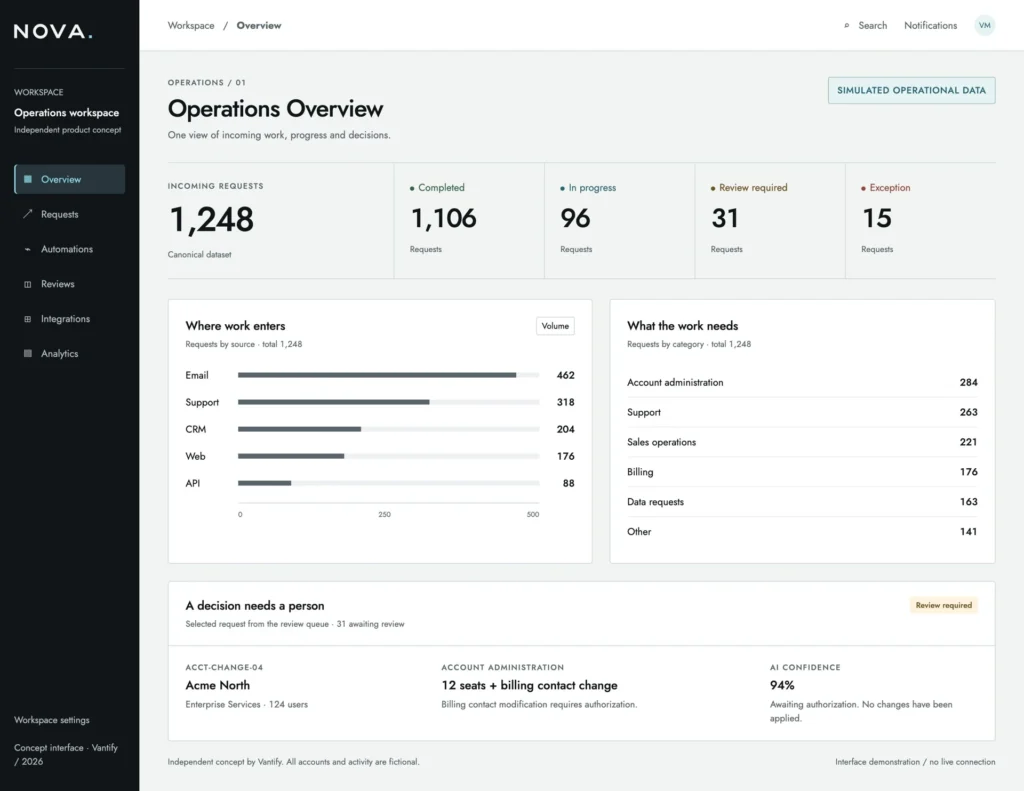
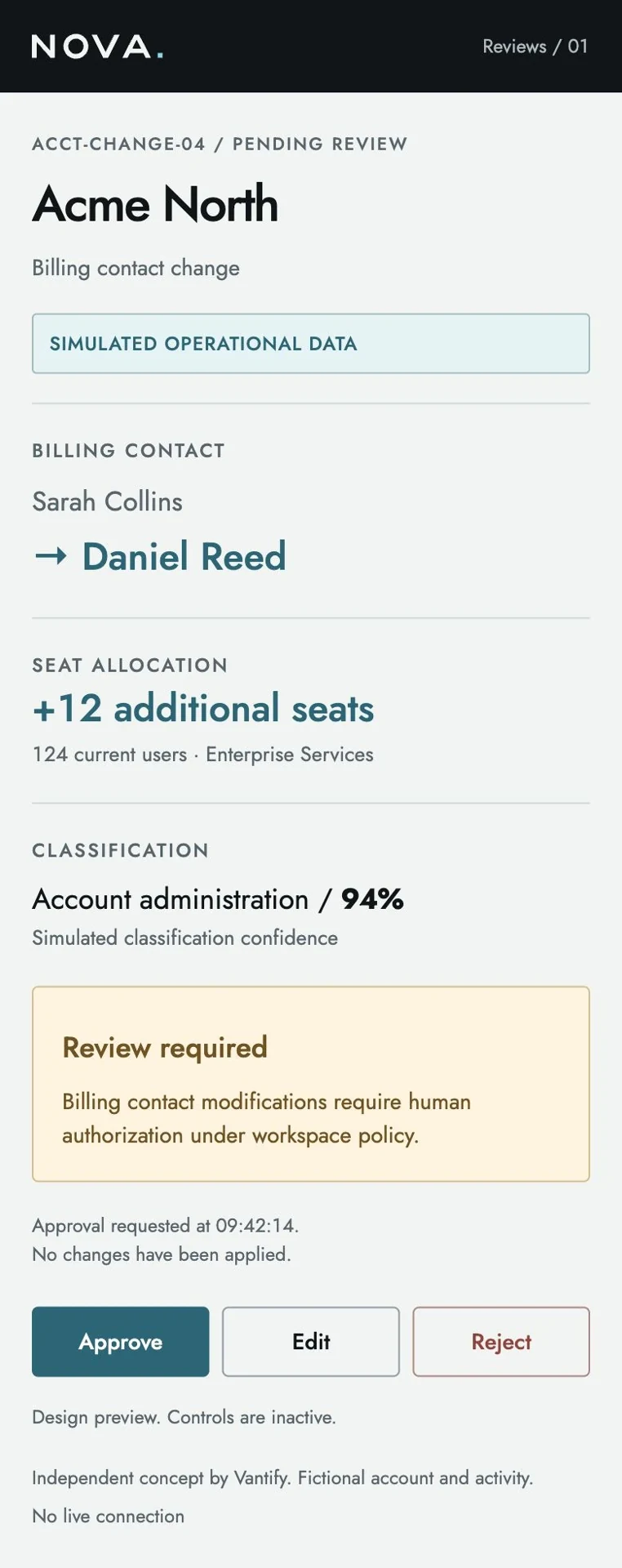
Request ACCT-CHANGE-04 concerns Acme North, an account with 124 users. The request asks for 12 additional seats and a new billing contact. Classification confidence is 94%.
High classification confidence does not authorize a billing modification. Workspace policy requires human authorization. At this snapshot, no changes have been applied.
A route that can be followed.
Email received → Classify request → Retrieve CRM account → Account change → Extract modifications → Billing details changed → Human approval → Update account → Update CRM → Send confirmation.
The approval boundary sits before writes. A rejected or incomplete request cannot silently continue into an account update.
AUTOMATE REPEATABLE ACTIONS. SURFACE UNCERTAINTY.
Escalate sensitive decisions. Preserve accountability. The reviewer sees the original request, extracted changes, 94% classification confidence and the rule that stopped execution.
Approve, Edit & approve, and Reject have different consequences. An edited approval records the revised instruction and the reviewer; rejection ends the write path.
Nothing has happened yet.
09:42:11 — Request received.
09:42:12 — Intent classified and account matched.
09:42:13 — Entities extracted.
09:42:14 — Human approval requested.
This is the awaiting-authorization snapshot. Later writes are proposed workflow steps, not completed events. A timeout or failed CRM write enters an exception state with a responsible owner and a retriable, recorded action.
Measure the work and its exceptions.
SIMULATED OPERATIONAL DATA: 1,248 requests = 1,106 completed + 96 in progress + 31 review required + 15 exceptions.
Sources: Email 462; Support 318; CRM 204; Web 176; API 88. The same total is maintained across the overview and analytics. These figures describe the interface scenario, not a client result.
A boundary for every connected system.
Email and support provide inputs. CRM supplies account context. Policy controls write access. Reporting reads the execution record. Each connection has a defined role; the interface does not assume blanket access to every system.
The small screen keeps the decision.
Mobile Review preserves the change, policy and action choices. Dense system context moves behind a deliberate inspection step; the approval decision remains legible.
The concept demonstrates operational logic, product design, information hierarchy and responsive review. It makes no claim of deployed integrations or measured productivity gains.
Apply the thinking to your business.
Explore how this project relates to AI & Automation.
A project by Vantify.
Independent concept by Vantify. Brand, products and commercial scenarios were created for demonstration purposes.