

WEB DESIGN & DEVELOPMENT
A better website.
A stronger business.
Clear positioning. Distinctive design. Thoughtful engineering. Websites and web applications built to turn interest into a useful next step.

DESIRE → UNDERSTANDING → ACTION
STRATEGY BEFORE INTERFACE
Give every page a job.
- 01Audience
- 02Content
- 03Journey
- 04Action
A website is a communication system and an operational interface. It needs to explain the offer, answer the questions that matter and make the next step clear. Before choosing a layout, we map audiences, search intent, content and the decisions people need to make.
Information architecture establishes the page relationships. Conversion planning connects a visitor’s starting point with a useful action. A redesign should preserve valuable content and working routes while correcting the parts that create confusion.
EXPERIENCE DESIGN
Hierarchy that survives a smaller screen.
- 01Hierarchy
- 02Interaction
- 03Responsive layout
Typography, spacing, interaction and responsive behaviour work together. The important message should stay clear on a phone, with a keyboard and at increased text sizes. Mobile composition is designed deliberately rather than treated as a narrow desktop layout.
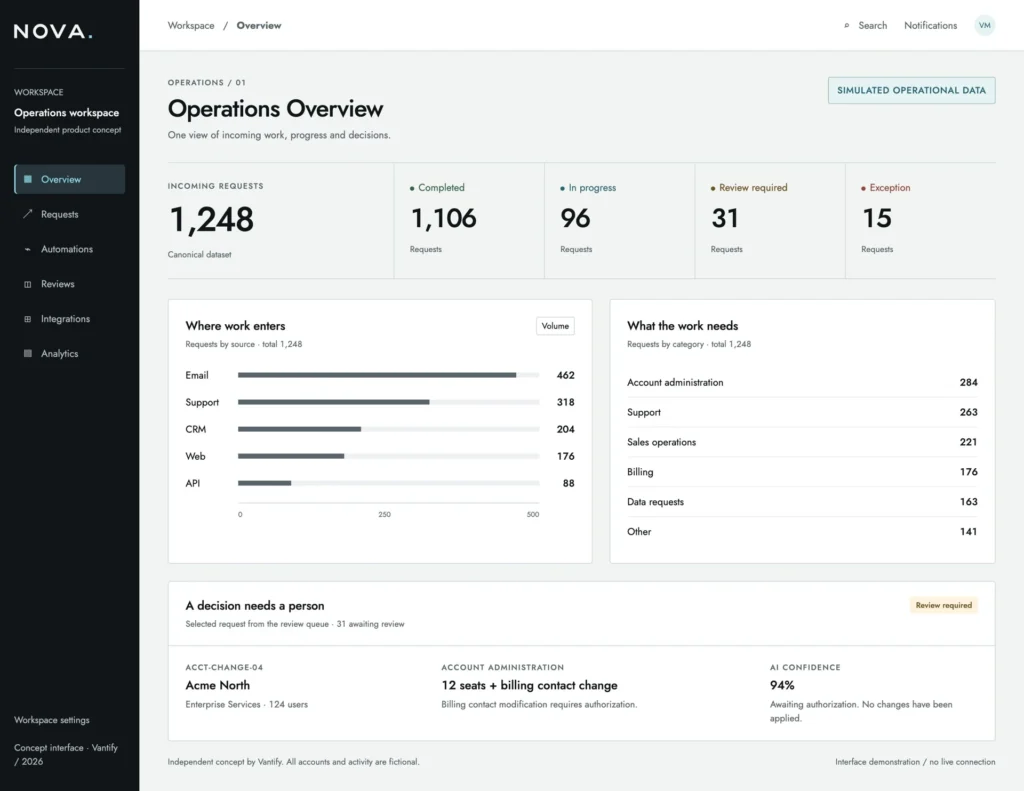
The specimen below demonstrates how the same information can change arrangement while keeping a natural reading order. It is an illustrative interface, not a performance benchmark or client project.
CUSTOM WEB APPLICATIONS
Useful software.
Considered interfaces.
Customer portals, internal tools and operational applications should feel as considered as your public website. We design around real tasks, clear permissions and the people using the system.
ENGINEERING & OWNERSHIP
Build for the next edit.
- 01Content ownership
- 02Engineering
- 03Maintenance
WordPress and Elementor can provide practical ownership of routine content. A custom front-end layer may support interactions that ordinary widgets cannot express, while headings, copy, links and media remain editable in the CMS.
The technical approach follows the scope. We identify what the owner needs to change, which behaviours require engineering and how updates will be tested. Dependencies, custom components and recovery procedures should be documented at handover.
PERFORMANCE & ACCESSIBILITY
Make the experience work under constraints.
- 01Performance
- 02Accessibility
- 03Reliability
Performance budgets shape media, fonts and JavaScript before the build becomes difficult to simplify. Responsive images, selective loading and progressive enhancement help keep the page usable when media is slow or an interaction fails.
Accessibility includes semantic structure, contrast, keyboard operation, visible focus, reduced motion and form feedback. Lab measurements and manual checks inform review; they are not a substitute for field data or a claim that every device has been certified.
SEARCH & CONTENT
A clear site is easier to understand.
- 01Search intent
- 02Crawlable content
- 03Internal links
Search-ready foundations include useful crawlable content, descriptive titles, sensible headings, internal links and appropriate metadata. Answer-engine readiness starts with the same clarity: what the service is, who it helps and how the work is approached.
Initial implementation and ongoing search work are different scopes. Content strategy, technical monitoring and conversion improvement may continue after launch. Neither rankings nor AI citations can be guaranteed.
COMMERCE & INTEGRATION
The journey continues after the click.
- 01Browse
- 02Choose
- 03Enquire
- 04Connect
Commerce, enquiries and account experiences depend on systems beyond the interface. We define what information is collected, where it goes, who owns the next action and how errors are handled.
Payment, stock, CRM and third-party services require compatibility and security checks before commitments are made. A visually complete form or checkout is not ready until its real processing and recovery paths have been tested.
HOW VANTIFY WORKS
A clear sequence. Room for what we learn.
Understand. Review the business goal, users, existing systems and constraints.
Architect. Define responsibilities, dependencies, decision boundaries and measures.
Build. Implement a bounded version, test real scenarios and document ownership.
Scale. Compare with the baseline. Improve and expand when evidence supports it.
Questions before we begin
Do you work with WordPress and Elementor?
Yes. The implementation approach can retain native Elementor ownership of routine content while isolating advanced behaviour in maintainable code.
Can an existing website be redesigned?
The starting point is an audit of content, journeys, technology and search value. Useful material and working routes should be preserved.
What will remain editable?
Headings, paragraphs, links, images and routine page sections belong in the CMS. Engineering-dependent interactions are documented separately.
Is ongoing SEO included?
Search-ready implementation and ongoing SEO are separate scopes. The project agreement should define each clearly.
Can you integrate business systems?
Compatibility, permissions and supported interfaces must be assessed before a delivery commitment is made.

AL SIDDIQUE BAKERS / CLIENT WORK
A bakery’s digital
shopfront.
From website development to SEO and marketing. Explore two connected chapters of one real engagement.
See the thinking in practice.
Explore the product and business decisions behind our independent concepts.
What are you trying to change?
Describe the business problem, the people it affects and the point where progress slows down.